

Losing a tooth can affect much more than the appearance of your smile. Missing teeth may influence the way you chew, speak, and feel about your smile, while changes in the surrounding bone and neighboring teeth can occur over time. For patients looking for a long-term solution, dental implants are one of the established options for replacing missing teeth.
Unlike a removable denture, a dental implant is placed into the jawbone and serves as an artificial tooth root. Once properly integrated with the bone, it can support a crown, bridge, or certain types of dentures. However, getting dental implants is a process rather than a single appointment, and understanding what to expect can help you make a more informed decision.
What Are Dental Implants?
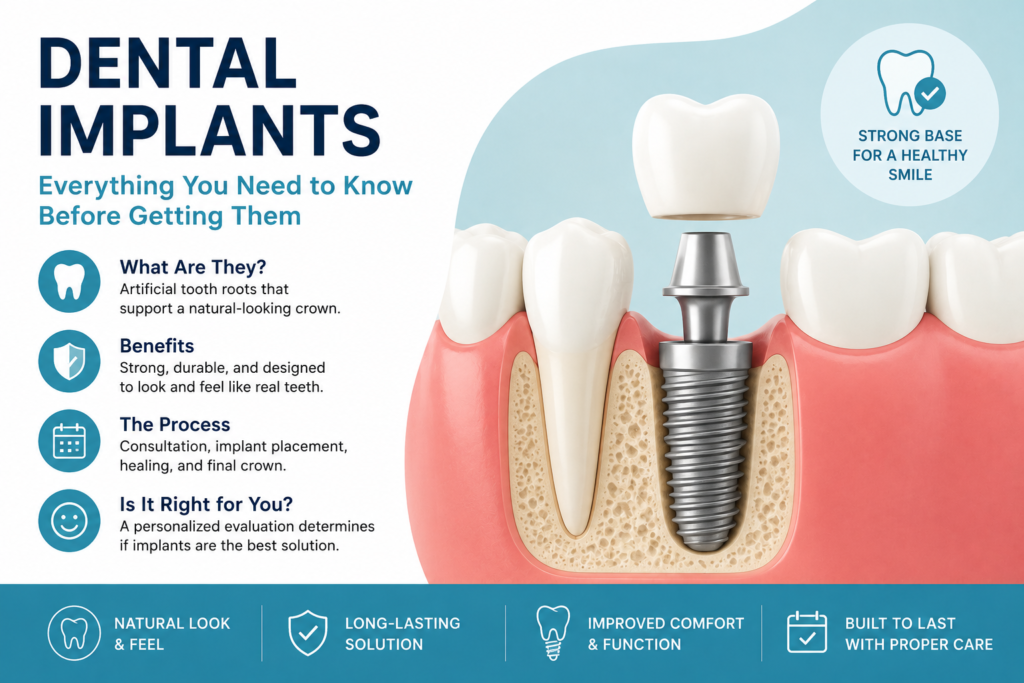
A dental implant is a small fixture, most commonly made of titanium, that is surgically placed into the jawbone where a natural tooth root was previously located. After healing and integration with the surrounding bone, the implant provides a stable foundation for the restoration that will replace the visible portion of the missing tooth.
A complete implant restoration generally consists of three main components: the implant itself, an abutment that connects the implant to the restoration, and a dental crown or another prosthetic restoration.
Because the implant is anchored in the jaw rather than simply resting on the gums, it can provide stability and function that more closely resemble those of a natural tooth.
Who Can Get Dental Implants?
Many adults who have lost one or more teeth may be candidates for dental implants, but suitability needs to be assessed individually.
Good general and oral health, adequate jawbone volume, healthy gums, and the ability to maintain proper oral hygiene are important considerations. Your dentist will also review your medical history, medications, smoking habits, previous dental treatments, and other factors that could influence healing or treatment planning.
Having insufficient bone does not automatically mean implants are impossible. Depending on the individual situation, procedures such as bone grafting may sometimes be considered to create a more suitable foundation for implant placement.
A comprehensive dental examination is therefore essential before deciding whether implants are appropriate.
Why Is Jawbone Health Important?
Dental implants rely on the jawbone for support. After an implant is placed, the surrounding bone needs time to heal around and integrate with its surface through a biological process known as osseointegration.
For this reason, the amount and quality of available bone are carefully evaluated during treatment planning.
When a tooth has been missing for a long period, some loss of bone volume may occur in that area. Your dentist may use dental imaging to evaluate the bone and determine whether additional procedures are necessary before or during implant placement.
What Happens During a Dental Implant Consultation?
The first stage is a detailed assessment rather than the implant procedure itself.
Your dentist will examine your teeth and gums, evaluate the area of the missing tooth, discuss your medical and dental history, and determine what type of restoration may be suitable. X-rays and, when indicated, three-dimensional imaging may be used to assess bone anatomy and surrounding structures.
This planning stage is extremely important because implant treatment needs to consider not only where the implant can be placed, but also where the final replacement tooth needs to be positioned for proper function and appearance.
Your dentist should also explain the expected treatment stages, possible alternatives, potential risks, estimated healing period, and maintenance requirements.
How Does the Dental Implant Procedure Work?
Dental implant treatment usually takes place in several stages.
First, the implant is surgically positioned in the planned area of the jawbone. The area is then allowed to heal so the implant can integrate with the surrounding bone.
Depending on the individual case and treatment approach, an abutment may be connected during the initial procedure or at a later stage. Once the implant has achieved appropriate stability and the tissues are ready, the final crown, bridge, or implant-supported prosthesis can be made and attached.
The exact sequence varies considerably between patients. Some cases are relatively straightforward, while others require tooth extraction, bone grafting, soft-tissue procedures, or additional healing time.
How Long Does Dental Implant Treatment Take?
One of the most important things to understand before choosing implants is that the entire treatment is not necessarily completed quickly.
Although implant placement itself may be performed during a single appointment, healing and osseointegration take time. The overall process can therefore last several months, particularly when additional procedures such as bone grafting are required.
In selected cases, immediate or early restoration may be possible, but not every patient is a suitable candidate. The safest treatment timeline depends on bone quality, implant stability, location, general health, bite forces, and other clinical factors.
For this reason, advertised promises of extremely fast implant treatment should always be considered in the context of an individual professional assessment.
Does Getting a Dental Implant Hurt?
Implant placement is generally performed using local anesthesia, which is intended to prevent pain during the procedure. Sedation may also be considered in some circumstances depending on the patient and treatment.
After the procedure, some discomfort, tenderness, bruising, or swelling can occur. The intensity and duration vary depending on the complexity of the surgery and individual healing response.
Your dental professional will provide instructions for managing the postoperative period and explain which symptoms are expected and which require further evaluation.
Severe or increasing pain, significant swelling, persistent bleeding, fever, or other concerning symptoms should be reported to the treating dental professional.
What Are the Benefits of Dental Implants?
One of the major advantages of implants is their ability to replace missing teeth without necessarily relying on neighboring teeth for support.
When replacing a single tooth, an implant-supported crown can function independently rather than requiring adjacent teeth to support a traditional bridge. Implants can also be used strategically to support larger restorations when several or all teeth are missing.
Patients often choose dental implants because they can provide:
- stable support for replacement teeth
- improved chewing ability
- a natural-looking restoration
- support for single crowns, bridges, or dentures
- improved stability compared with some removable solutions
- a long-term approach to replacing missing teeth.
However, implants are not maintenance-free and are not guaranteed to last indefinitely.
Dental Implants vs. Dental Bridges
Both implants and bridges can be effective ways to replace missing teeth, but they work differently.
A traditional dental bridge typically uses neighboring teeth as support for the replacement tooth. This may require those teeth to be prepared for crowns.
A single dental implant, in contrast, is supported by the jawbone and can replace the missing tooth without using adjacent teeth as the primary support.
That does not mean implants are automatically the best choice in every situation. The condition of neighboring teeth, available bone, treatment time, medical factors, cost, personal preferences, and long-term treatment goals should all be considered.
A dentist can explain which option is more appropriate for your specific situation.
Dental Implants vs. Dentures
Traditional removable dentures rest on the gums and can replace several or all missing teeth. They remain an important and appropriate treatment option for many patients.
Implants offer another possibility. Several strategically positioned implants may sometimes be used to improve the retention and stability of a removable denture or to support a fixed restoration.
The best solution depends on the number and position of missing teeth, bone anatomy, oral health, budget, expectations, and other individual factors.
For some patients, a removable solution may be preferable. For others, implant-supported treatment may offer the stability and function they are looking for.
Can Dental Implants Fail?
Yes. Although dental implants can have high success rates in appropriately selected and managed cases, failure is possible.
An implant may fail to integrate properly with the bone, or complications can develop later. Infection and inflammation around an implant, excessive mechanical forces, certain health factors, smoking, inadequate oral hygiene, and insufficient maintenance may negatively affect long-term outcomes.
A condition involving inflammation of the tissues around an implant, known as peri-implant disease, can potentially damage the tissues and bone supporting the implant.
This is why choosing implants does not eliminate the need for excellent oral hygiene and regular professional dental care.
How Long Do Dental Implants Last?
Dental implants are intended as a long-term tooth replacement option, but it is misleading to promise that an implant will last for life.
Longevity varies between individuals and depends on numerous factors, including oral hygiene, gum and bone health, smoking, general health, bite forces, implant position, quality of the restoration, and regular professional maintenance.
It is also important to distinguish between the implant itself and the restoration attached to it. A crown or other prosthetic component may eventually require repair or replacement even when the implant remains healthy and stable.
The best approach is therefore to think of implants as a long-term treatment that still requires lifelong maintenance.
How Do You Care for Dental Implants?
An implant-supported tooth may look and function similarly to a natural tooth, but it still requires careful cleaning.
Daily brushing and appropriate cleaning around and between implant restorations are essential. Depending on the restoration, your dentist or dental hygienist may recommend specific interdental brushes, flossing techniques, or other cleaning tools.
Regular professional examinations are also important. These appointments allow the dental team to monitor the implant, surrounding gums, bone, bite, and restoration.
One of the biggest mistakes a patient can make is assuming that an artificial tooth cannot develop problems simply because it cannot develop a cavity in the same way as a natural tooth.
The surrounding tissues can still become inflamed and require proper care.
Smoking and Dental Implants
Smoking is an important factor to discuss before implant treatment because it can negatively affect oral tissues and healing and is associated with an increased risk of implant-related complications.
Patients who smoke should be open with their dentist during treatment planning. The dental professional can explain how smoking may influence the individual case and discuss measures that may improve the chances of a successful outcome.
Hiding medical conditions, medications, or smoking habits from your dental team can interfere with appropriate treatment planning.
What About Dental Implants for Multiple Missing Teeth?
Dental implants are not limited to replacing individual teeth.
When several teeth are missing, implants may support a dental bridge, reducing or eliminating the need for an individual implant for every missing tooth in certain treatment plans.
For patients missing all or most teeth in an arch, implant-supported removable or fixed restorations may also be considered.
These cases require detailed planning because implant number, position, bone availability, bite forces, aesthetics, and prosthetic design all need to work together.
What Are the Most Common Mistakes Patients Make?
One of the most common mistakes is choosing treatment based solely on price. Implant dentistry involves surgical planning, restorative planning, materials, professional expertise, follow-up care, and long-term maintenance.
Another mistake is expecting the entire procedure to be completed immediately. Although faster protocols are possible in selected patients, adequate healing cannot simply be ignored.
Patients may also underestimate the importance of oral hygiene after treatment. An implant is not a replacement for proper dental care.
Finally, comparing implant offers only by the number of implants or the advertised price can be misleading. The complete treatment plan, type of final restoration, diagnostic procedures, additional treatments, follow-up care, and professional expertise should all be considered.
What Should You Ask Your Dentist Before Getting Dental Implants?
Before making your decision, make sure you understand the complete treatment plan.
Useful questions include:
- Am I a suitable candidate for dental implants?
- Do I have enough healthy bone?
- Will I need bone grafting or another additional procedure?
- How many implants are recommended?
- What type of restoration will be placed?
- How long is the expected treatment process?
- What are the alternatives?
- What risks apply to my particular case?
- What will recovery involve?
- How should I maintain my implants afterward?
- What is included in the treatment cost?
A good consultation should give you enough information to make an informed decision without feeling pressured.
Are Dental Implants Worth It?
For the right patient, dental implants can provide a stable, functional, and aesthetically pleasing way to replace missing teeth. Their value is particularly evident when treatment is carefully planned, performed appropriately, and followed by good oral hygiene and regular professional maintenance.
However, implants should never be viewed as a universal solution. Traditional bridges, removable dentures, and other treatment approaches remain appropriate in many situations.
The best treatment is not necessarily the most advanced or expensive one. It is the option that appropriately addresses your oral health, functional needs, expectations, medical circumstances, and long-term goals.
Thinking About Dental Implants? Start With a Professional Assessment
If you are missing one or more teeth and considering dental implants, the first step should be a comprehensive dental consultation. Proper examination and treatment planning can determine whether implants are suitable for you and what approach is most appropriate.
Understanding the process before treatment makes it easier to set realistic expectations about surgery, healing, cost, maintenance, and final results.
Dental implants can be an excellent long-term solution for missing teeth – but successful treatment begins with careful planning, realistic expectations, and professional dental care.